
React Native Elements — My Journey through Open Source
Originally published on Medium on March 24, 2018, where it has gathered 655 claps as of September 2026. Ported here as written, so the numbers in the body are March 2018's.
I first got involved with Open Source in late 2016 when I was learning how to build React Native apps. I had been developing iOS apps before then, and was aware of the huge open source ecosystems surrounding different technologies but never got the opportunity to create or contribute to an open source project.
So sometime around October 2016, I came up with the idea of creating a RN boilerplate app that uses the best npm packages & comes prepackaged with the most commonly used technologies such as React Redux, Navigation, Vector Icons etc. That was my first ever open source project. You can check it out here.
Since then I have come a long way with respect to Open Source, creating multiple npm packages as well as maintaining React Native Elements, which is the most popular UI library for React Native. Here is a snapshot of my Github profile:
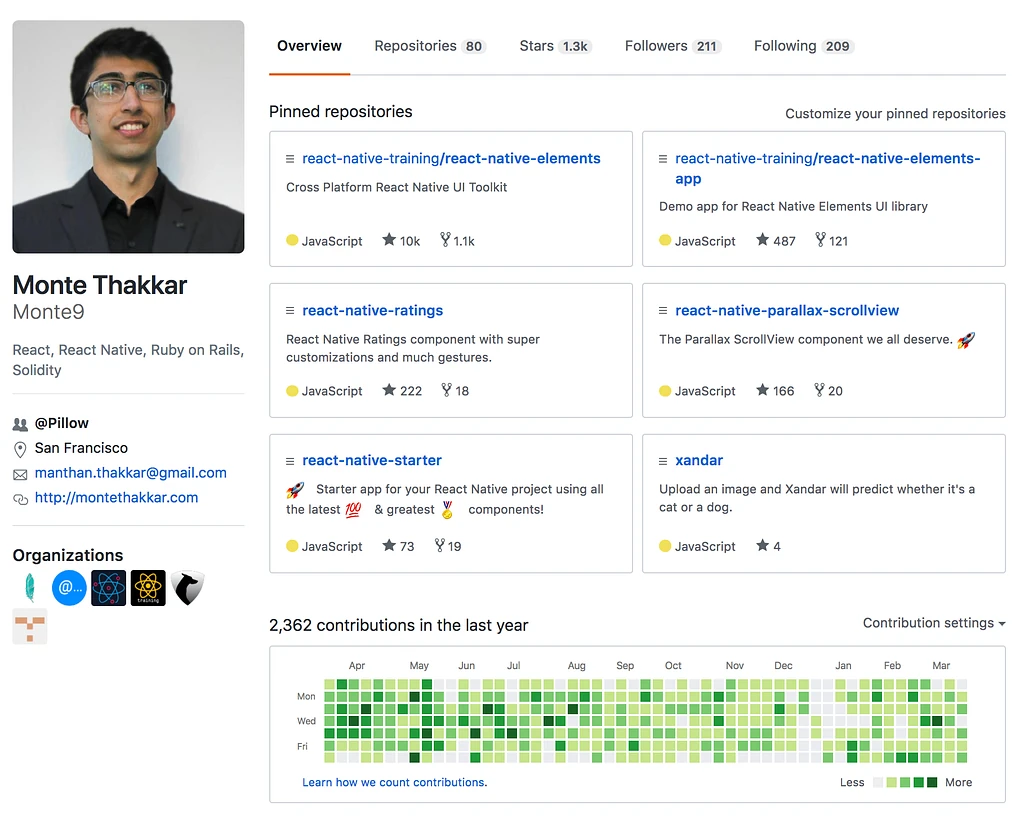
Recently, React Native Elements reached 10,000 🌟 stars on Github which is a major milestone and the only other library to do so (in the React Native ecosystem) is React Navigation. So I took this opportunity to share with everyone a bit about how we got here through a Twitter thread. I have added the tweets below for easy reading. Here we go:
 Monte Thakkar @montethakkar
 React Native Elements just reached a HUGE 🚀 milestone of being one of the first 🥇 @reactnative libraries to reach 10K 🌟 stars. What started as a weekend project by @dabit3 has now become the most popular UI library for RN. This thread is about how we go here...
Monte Thakkar @montethakkar First some stats: RNE is one and a half (1 1/2) years old. 👵 ~ 1,200 commits to master 📲 ~ 600 issues closed 🔒 ~ 400 pull requests merged 🛠️ ~ 100 contributors (6 core contributors) 👨👩👦👦 ~ $2000 received & paid out through @opencollective 🤑
Monte Thakkar @montethakkar First Commit: Nader Dabit, Sept 8th, 2016. I remember him saying that he just put together a bunch of components over a weekend and open sourced it. Initial version 0.0.2 had about 10 components. github.com/react-native-training/react-native-elements/commit/bb3f991
Monte Thakkar @montethakkar It would be really interesting to hear his side of the story on what made him start RNE and what his thought process was! Anyways, Nader continued to work on it over the next few months, fixing issues & addressing PRs.
Monte Thakkar @montethakkar Around December 2016, Nader published v0.8.2 and in just 3 months RNE was already at 3K 🌟 stars. That's where I come in.. 🏃♂️
Monte Thakkar @montethakkar I had been dev RN apps for 6 months and had used RNE before. I noticed that Nader was the only 1 maintaining it and offered to help him. Nader agreed (as I believe he was busy with other projects) and I helped publish v0.9.0, my first ever open source release!
Monte Thakkar @montethakkar Quick stats update: December 23, 2016 ~ v0.9.0 💾 ~ 231 commits 📲 ~ 3K stars 🌟
Monte Thakkar @montethakkar Once I came on board, Nader fully trusted my ability to maintain RNE and almost gave me full control of the repo instantly. I believe that this immensely boosted my self-confidence and gave me the freedom to be creative with the repo and see how far I could take it.
Monte Thakkar @montethakkar Thanks for doing that @nader! 🙏 I was super passionate about RN at the time (and still am) and over the next few months I put in a lot of time and effort into addressing issues, merging PR's and releasing new versions.
Monte Thakkar @montethakkar And along the way, I learned how to write good maintainable code, brainstorm new feature ideas with others and also how to communicate effectively and help fix issues. Enter @binoyp14! 😎
Monte Thakkar @montethakkar Binoy was 1 of the most active contributors around that time and after I reviewed a few of his PRs and a few discussions over @github issues, I decided to bring it onboard as one of the core contributors. And I believe that was one of the best decisions I made for RNE.
Monte Thakkar @montethakkar One of the things I learned early on (esp with Open Source) is that if someone is passionate about a project/library, they will actively participate in discussions and help out with the repo.
Monte Thakkar @montethakkar So if you can spot these folks that are really committed to helping the repo grow.. you should embrace it and give them more control. Just like Nader did with me. Thanks again @dabit3! 🙏
Monte Thakkar @montethakkar Anyways, Binoy helped with RNE for the next 6 months and we ended up attending Chain React conference in Portland together. Soon after, he graduated college and got busy with the job hunt. Still amazes me how Open source helps create such friendships. ❤️
Monte Thakkar @montethakkar And then finally came @roach_iam, @xaviervllgr & @Guizmomartinez. As I said earlier, spotting folks that are interested to help the library grow and bringing them onboard is 🔑. I communicated to them that they were awesome and I would love to have them shape the future of RNE!!
Monte Thakkar @montethakkar They happily agreed and the 4 of us are now the core team maintaining RNE. All 3 of them have been instrumental in helping RNE reach 10K 🌟 stars. They are creative, smart, good team players and obviously, rockstar react native developers. 🔥 #teamworkmakesthedreamwork
Monte Thakkar @montethakkar And finally, here we are!! 10K 💫✨ WOW! Throughout the last 1 1/2 years, RNE has been a constant in my life and I have become a much better developer and a more compassionate person through #OpenSource. Here's to the future of RNE v1! 🎉
Huge shoutout to Nader Dabit, Binoy Patel, Kyle Roach, Xavier Villelégier and Guillaume Martinez without whom this journey would be incomplete. ❤️
I hope you enjoyed reading this post. Feel free to hit me up if would like to get involved with Open Source projects such as RNE or just get a cup of coffee (online or IRL) and have a conversation. ☕️ 🗯
Sources
- The original: React Native Elements — My Journey through Open Source, on Medium, March 24, 2018.
- The Twitter thread the post unrolls, and the React Native Elements repository.
- The stars photo is from r/spaceporn, as credited in the original.